How elephant seals can help us understand a changing Southern Ocean
Every year, thousands of elephant seals leave subantarctic islands and disappear into the vast Southern Ocean for months at a time. Out there – often thousands of kilometres from land – they dive continuously, hunting in the dark depths of one of the planet’s most remote and rapidly changing marine ecosystems.
For ACEAS postdoctoral researcher and marine ecologist Dr David Green from the University of Tasmania, these extraordinary animals are more than charismatic predators. They are data collectors and ecosystem sentinels – a crucial key to understanding how the Southern Ocean is responding to climate change.
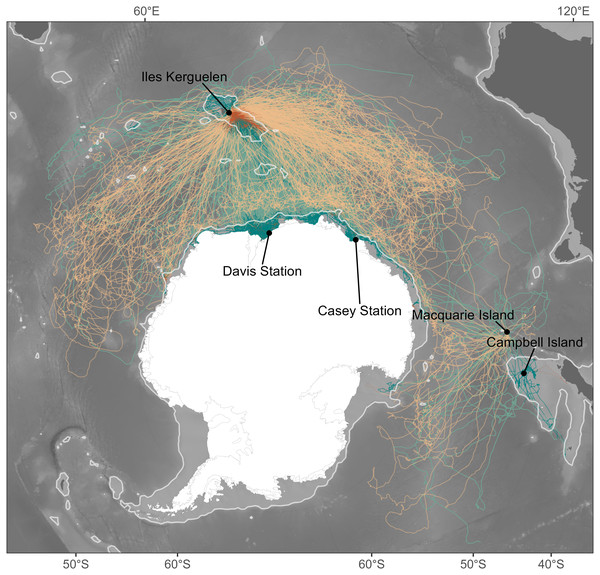
Dr Green’s latest study, published in PeerJ, draws on more than 20 years of tracking data from over 600 elephant seals. It is one of the largest marine predator datasets ever assembled. The findings offer new insights into how seals make decisions underwater and how scientists can interpret predator behaviour to detect ecosystem change.

What motivates a deep diving study like this?
Scientists have long known where elephant seals travel and how deep they dive. These animals routinely reach depths of 300 to 800 metres, with some plunging to 2.4 kilometres – deeper than the Grand Canyon at its greatest depth.
But understanding why they dive the way they do, once they leave land and vanish beyond the reach of direct observation, has remained a major challenge.
“Elephant seals spend more than 90 per cent of their time underwater,” Dr Green explains. “We’ve had good information on where they go and how deep they dive, but far less on what their behaviour actually means – especially when they’re thousands of kilometres offshore.”
One particular type of dive, known as a ‘drift dive’, provides a rare window into what’s happening below the surface. During these dives, seals stop swimming and simply drift. Their vertical speed changes depending on whether they are gaining or losing fat – offering a direct measure of foraging success.
With millions of dives recorded across more than 600 individuals, Dr Green and his colleagues had an unparalleled dataset for revisiting long‑standing ideas about how predators forage in patchy, unpredictable environments.

Revisiting classic foraging theory – with elephant seals as the test case
A central question in predator ecology is how animals adjust their dive behaviour when prey availability changes. Does a longer dive suggest abundant prey? Or does a shorter dive indicate the seal has found a rich patch and can feed efficiently before resurfacing?
To explore this, the study compared two major ecological frameworks:
- The classic interpretation: longer dives mean better feeding opportunities, with seals staying at depth because they are finding more prey.
- The Marginal Value Theorem: a dominant ecological theory predicting that when conditions are good overall, animals spend less time in any one foraging patch – quickly exploiting abundant resources before moving on.
After accounting for factors such as buoyancy (which shifts with body condition) and habitat type, Dr Green found strong support for the Marginal Value Theorem. When foraging success improved, elephant seals made shorter, steeper dives: they descended, fed efficiently, and returned to the surface sooner.
This pattern was remarkably consistent across males and females, shallow shelf waters and deep ocean basins, and across multiple years.
“No matter where they were or which animal we looked at, the pattern was the same,” Dr Green says.
A dataset decades in the making
What sets this research apart is the sheer scale of the available data. While similar studies often rely on 20 to 30 tracked animals, this multi‑decade dataset covered 609 seals, with detailed measurements of both dive effort and foraging success.
“It’s extremely rare to have such long‑term, individual‑level data,” Dr Green says. “That’s what allowed us to reveal such clear, robust patterns.”
This investment now underpins a wide range of Southern Ocean ecosystem studies, demonstrating the ongoing value of fundamental research.
A surprising finding: surface recovery doesn’t change
Many marine predators require longer recovery at the surface after intense feeding. Elephant seals are different.
Thanks to exceptional physiological adaptations – including large blood volumes and high oxygen‑binding capacity – they rarely exhaust their oxygen stores and can avoid anaerobic metabolism during most dives. As a result, they recover efficiently without needing extended time at the surface.
Dr Green found no increase in surface recovery time, even when seals were foraging extremely successfully.
“They’re champion divers,” he says. “Their physiology is so specialised that surface behaviour doesn’t show the same cues we see in other species.”
This makes elephant seals both highly valuable and uniquely complex indicators of ecosystem change.
Why this matters for understanding the Southern Ocean
Elephant seals are not just extraordinary animals – they are indispensable partners in monitoring the Southern Ocean.
Along with helping scientists better map the shape of the ocean floor – a critical part of the puzzle in understanding future icesheet melt – their dive behaviour and movements provide clues about prey distribution, how environmental conditions shape predator performance, and how marine ecosystems may shift under climate change.
By linking drift‑dive data (a direct measure of foraging success) with dive effort, Dr Green’s study strengthens the way researchers interpret behaviour in other marine predators, including penguins, sea lions and other seal species that cannot provide such detailed physiological signals.
These findings help the scientific community interpret what constitutes ‘good habitat’, improving habitat modelling and supporting marine protected area planning and sustainable fisheries management. This includes understanding overlap between male elephant seal habitat use and toothfish fisheries, ultimately ensuring that conservation efforts and management decisions are supported by a strong evidence base.
Elephant seals, with their astonishing dives, unique physiology and ability to gather environmental data far beyond the reach of ships or satellites, will continue to be powerful allies in this effort.
Read the paper
Read the full paper: Elephant seal dive behaviour responds consistently to changes in foraging success regardless of sex or ocean habitat by David B. Green, Sophie Bestley, Clive R. McMahon, Mary-Anne Lea, Robert G. Harcourt, Christophe Guinet and Mark A. Hindell.
Further resources
More research: explore some of Dr Green’s other research seeking to understand krill dynamics in the Southern Ocean around Antarctica.
Watch: learn more about ACEAS work to improve projections in physical climate and ecosystems in this video featuring Dr Green.
Subscribe to our newsletter
For more Antarctic news and stories, subscribe to our mailing list here.