News

COOKIES Blog #6 – International collaborative science at the edge of Antarctica

International collaborative science at the edge of Antarctica By Joline Lalime, Sea2SchoolAu and Dr Linda Armbrecht, ACEAS/IMAS (University of Tasmania) Research nearby the Cook Ice Shelf is only possible through strong international collaboration. This remote and poorly studied region of East Antarctica demands a wide range of expertise, technologies, and perspectives – and this voyage […]

COOKIES Blog #6 – International collaborative science at the edge of Antarctica Read More »
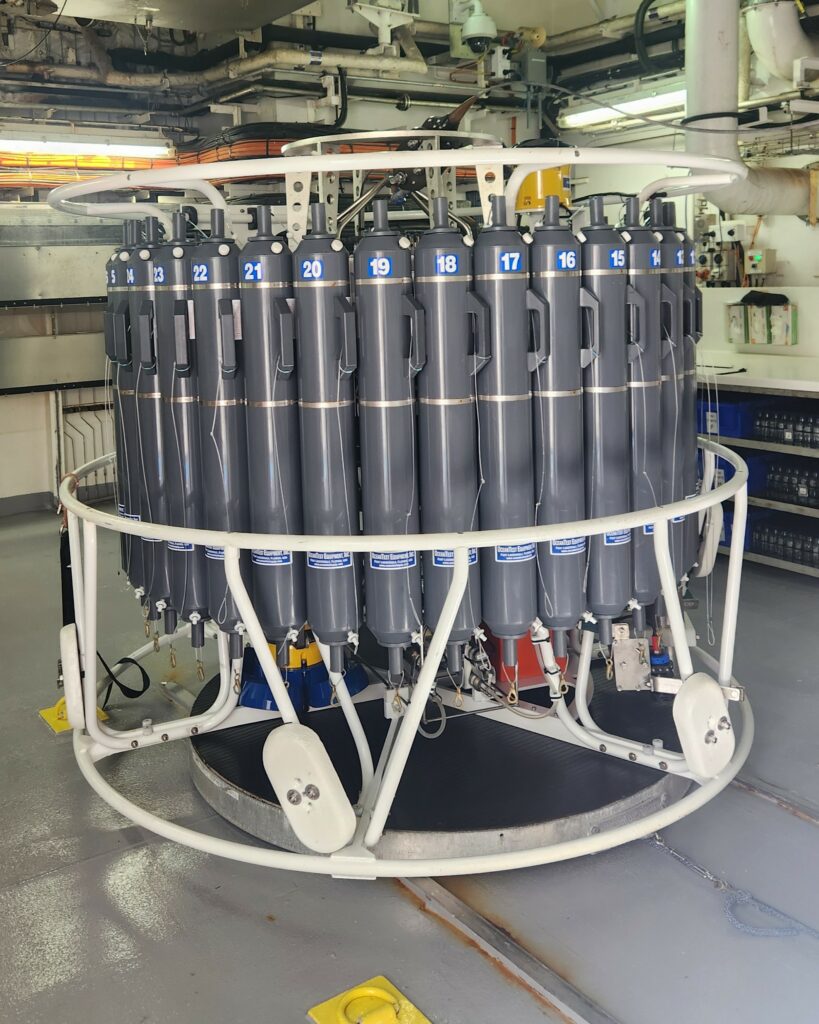
A CTD after it has been deployed – ready to be sampled by scientists. Each bottle/Niskin has been closed at a specific depth. Credit: Joline Lalime.

COOKIES Blog #7 – Global circulation and the humble CTD

Global circulation and the humble CTD By Izzy White, University of Southampton (England) and Joline Lalime, Sea2SchoolAU The world has five ocean basins: Pacific, Atlantic, Arctic, Indian, and Southern with the Atlantic and Pacific basins divided again into Northern and Southern parts. Figure 1: Diagram of the major ocean basins and their gyres. Source: https://oceaninfo.com/list/ocean-currents/

COOKIES Blog #7 – Global circulation and the humble CTD Read More »

Southern Ocean may store less carbon than climate models assume

Southern Ocean may store less carbon than climate models assume New research led by ACEAS PhD researcher Annika Oetjens and colleagues at the University of Tasmania reveals that the Southern Ocean may be storing less carbon than climate models assume – with important implications for future climate projections. The Southern Ocean plays an outsized role

Southern Ocean may store less carbon than climate models assume Read More »

International Women and Girls in STEM (Photo 1). L–R (Back): Lucinda Duxbury, Rebecca Knight, Izzy White, Dr Amy Leventer, Dr Sally Lau, Gina Paroz, Amy Wells, Ella Pietraroia, Pavie Nanthasurasak. L–R (Front): Dr Fiorenza Torricella, Dr Amaranta Focardi, Talia Hawkes, Sarah Jessop, Dr Linda Armbrecht, Dr Laura De Santis, Joline Lalime, Ana Gomes. Seated: Dr Jan Strugnell, Dr Katharine Prata. Image credit: CSIRO-Kieran Sheehan.

COOKIES Blog #8 – Leading from the front: women shaping Antarctic science on the COOKIES voyage

Leading from the front: women shaping Antarctic science on the COOKIES voyage By Joline Lalime, Sea2SchoolAU and Dr Linda Armbrecht, ACEAS/IMAS (University of Tasmania) Antarctica, the Southern Ocean and marine expeditions were once territories where women were excluded by tradition, superstition (bad luck), and systemic barriers. Today, that history is being actively rewritten through leadership,

COOKIES Blog #8 – Leading from the front: women shaping Antarctic science on the COOKIES voyage Read More »

Microscopy image of Corethron pennatum, a phytoplankton collected from surface samples of the Southern Ocean. Image credit: A. Focardi.

COOKIES Blog #9 – The invisible engineers of the Southern Ocean: a story from a drop of seawater

The invisible engineers of the Southern Ocean: a story from a drop of seawater By Amaranta Focardi, University of Technology Sydney, and Joline Lalime, Sea2SchoolAU Did you know that a single drop of seawater can contain millions of microbes? Much like the miniature universe hidden inside a marble in Men in Black, an entire world

COOKIES Blog #9 – The invisible engineers of the Southern Ocean: a story from a drop of seawater Read More »

Dr Amy Leventer, Timothy Nugroho, Dr Linda Armbrecht and Lucinda Duxbury (L-R) marking the core with toothpicks. Image credit: J. Lalime

COOKIES Blog #10 – ‘Pass the pool noodle’: the ordinary items doing extraordinary things for science at sea

‘Pass the pool noodle’: the ordinary items doing extraordinary things for science at sea By Lucinda Duxbury, IMAS/ACEAS (University of Tasmania) and Joline Lalime, Sea2SchoolAU ‘Who’s seen the toothpicks?’ ‘Pass the pool noodle.’   From what we’re saying, you wouldn’t guess we’re in a floating lab in East Antarctica. And no, the pool noodles aren’t

COOKIES Blog #10 – ‘Pass the pool noodle’: the ordinary items doing extraordinary things for science at sea Read More »

Background bathymetry of the Adélie Bank, Mertz Bank, and Ninnis Bank. Image credit: doi:10.1002/jgrc.20339.

COOKIES Blog #11 – Science and art meet in the Southern Ocean

Science and art meet in the Southern Ocean By Luca Magri, Institute for Marine and Antarctic Studies/University of Tasmania and Joline Lalime, Sea2SchoolAU The Southern Ocean is an immense water mass. The way it moves directly affects how other water masses circulate all around the globe, shaping the resulting climate systems from the tropics to

COOKIES Blog #11 – Science and art meet in the Southern Ocean Read More »

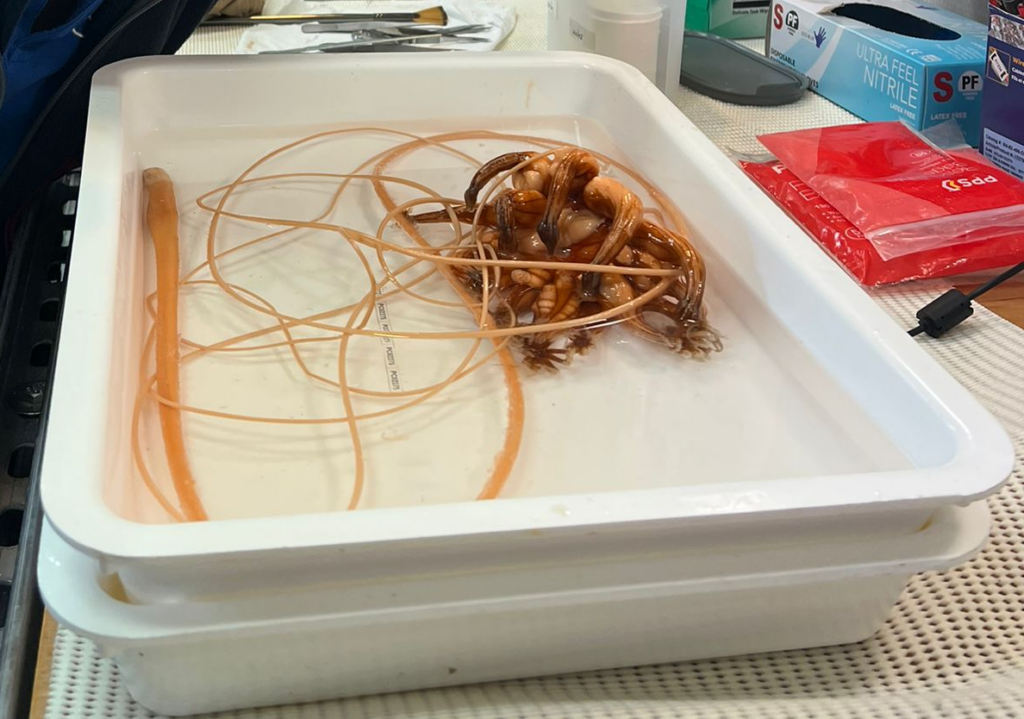
The ‘Demogorgon’ – an Umbellula sp. sitting in sampling tray waiting to be processed for DNA sampling and preservation for museum storage. Image credit: K. Prata.

COOKIES Blog #13 – Finding stranger things: catching a real-life ‘Demogorgon’ from the Antarctic deep

Finding stranger things: catching a real-life ‘Demogorgon’ from the Antarctic deep By Kat Prata, James Cook University/Securing Antarctica’s Environment Future (JCU/SAEF), Sarah Jessop, Institute for Marine and Antarctic Studies/University of Tasmania (IMAS/UTAS) and Joline Lalime, Sea2SchoolAU At first glance, you might think this strange-looking organism slipped through a fracture in space-time, perhaps via an Einstein-Rose

COOKIES Blog #13 – Finding stranger things: catching a real-life ‘Demogorgon’ from the Antarctic deep Read More »

COOKIES Voyage Group photo – Science Team, Crew and CSIRO Technical Team. Image credit: CSIRO-E. Pietraroia.

COOKIES Blog #14 – COOKIES wrap up: 55 Days in the Southern Ocean

COOKIES wrap up: 55 Days in the Southern Ocean By Dr Linda Armbrecht, Australian Centre for Excellence in Antarctic Science/Institute for Marine and Antarctic Studies (University of Tasmania) and Joline Lalime, Sea2SchoolAU Fifty-five days in the Southern Ocean is long enough to lose track of which day it is, but not long enough to lose

COOKIES Blog #14 – COOKIES wrap up: 55 Days in the Southern Ocean Read More »