Where Antarctic science meets policy
Two polar research programs led by the University of Tasmania have presented the most recent science from Antarctica and the Southern Ocean to around 80 policy makers from all tiers of government and the non-government sector.
The Australian Centre for Excellence in Antarctic Science (ACEAS) and the Australian Antarctic Program Partnership (AAPP) organised the inaugural Antarctic Science-Policy Dialogue at the Institute for Marine and Antarctic Studies on 8 April, to communicate the significance of rapid changes in the region for Australian policy.
In her opening address, Chair of the AAPP Management Committee Sue Weston said that science is critical to anticipate change, manage the environment, and play a leading role in Antarctic stewardship.
“More than at the ‘bottom of the world’ or ‘the edge of the map’, our research demonstrates that Antarctica and the Southern Ocean are in fact central to the Earth’s climate system, while at the same time acutely vulnerable to global warming,” she said.
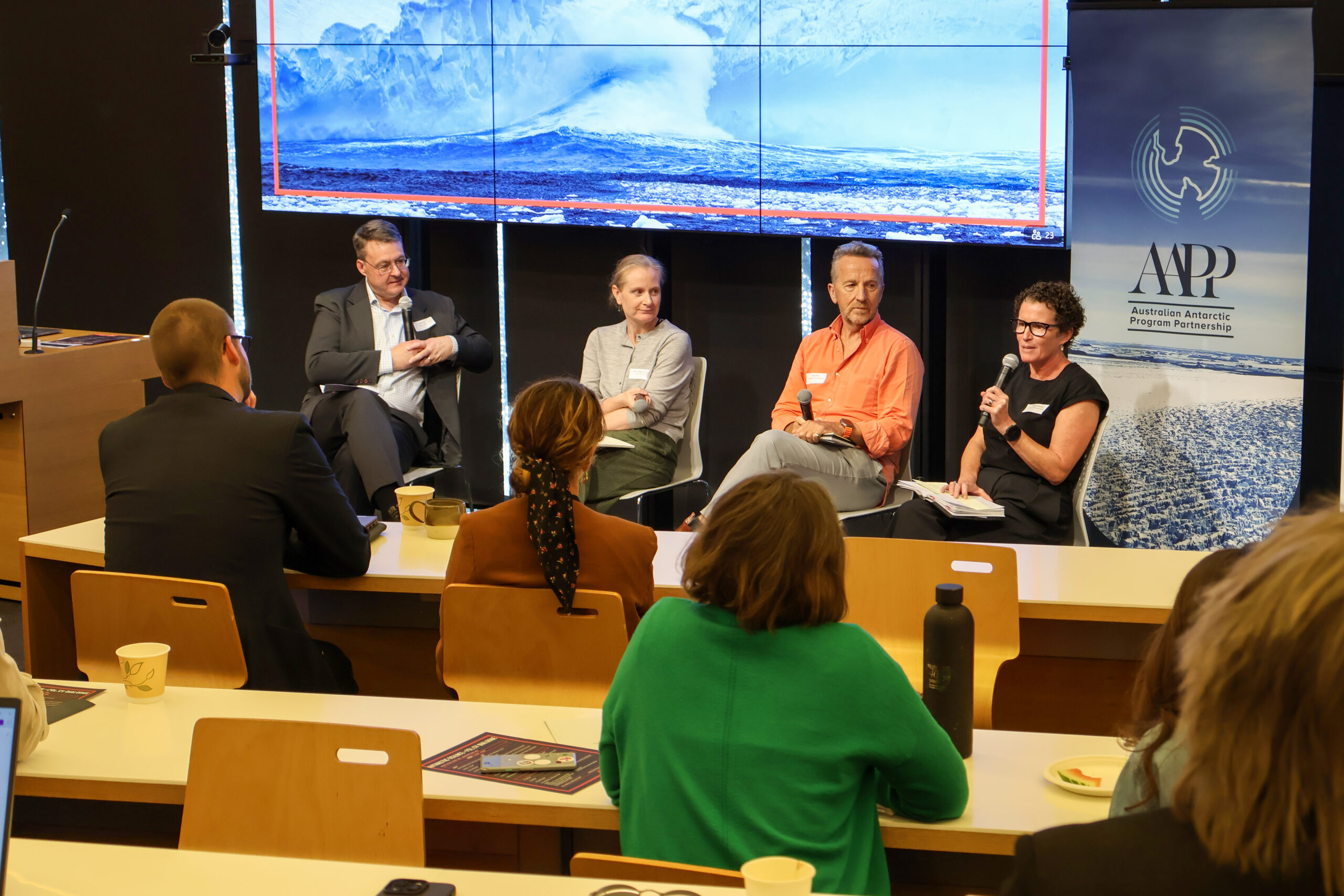
Insights for policymakers from the latest Antarctic and Southern Ocean research
Here are some snapshots from the presentations:
Emerging evidence: abrupt changes in the Antarctic environment
Professor Philip Boyd, marine biogeochemist
— “The emerging evidence of abrupt change really marks a very worrisome departure from the convention of gradual change. With that departure, it dramatically shortens the time that we have to plan for, but also to respond to the climate crisis.”
Tracking Southern Ocean CO₂: essential evidence for effective action
Dr Elizabeth Shadwick, marine biogeochemist
— “As of 2025, our best estimate of how much CO2 is going into the Southern Ocean is about 3 gigatons per year, but the uncertainty on that is large... 0.4 gigatons, which is about equivalent to all of Australia's national net emissions. So the annual emissions of Australia are the uncertainty on that number. Having an improved understanding of how much CO2 goes into the Southern Ocean is really critical for making decisions about what kind of future we're going to have, and whether we can rely on it to continue to provide us this service by taking up such a big fraction of our anthropogenic emissions.”
Supercool clouds: the missing piece of the Southern Ocean puzzle
Dr Sonya Fiddes, atmospheric scientist
— “In the Southern Ocean there aren't many sources of pollution [like dust, to seed clouds]. We have more super-cooled liquid water clouds in the Southern Ocean than we have anywhere else on Earth. Why is this important? Our models were mostly developed in the Northern Hemisphere, and in the Northern Hemisphere, this assumption that there's lots of dust or lots of pollution is generally okay. I wouldn't say it's right, but it's okay. But in the Southern Ocean, it's not okay. An ice cloud will let more sunlight through to the surface, whereas a liquid cloud is more reflective. Our models don't produce enough supercooled liquid water clouds.”
The awakening giant: Antarctic ice sheet change in a warming climate
Professor Poul Christoffersen, glaciologist
— “Australia has a 42% claim in Antarctica, so we are the proud owners of 15 million cubic kilometres of ice, which is changing in precarious ways. No doubt we need to study East Antarctic drainage basins more. What we have learned over the last 10 years or so is that some of the geometric factors that cause ice sheet instability, that was attributed mostly to Western Antarctica, are equally there in Eastern Antarctica. There are drainage basins, individual drainage basins in East Antarctica, that are as large as the entire West Antarctica.”
Modelling change: Antarctic ocean circulation in a warming world
Associate Professor Paul Spence, physical oceanographer
— “The Southern Ocean is a place of great renewal. It's where old water rises up to the surface and is sent back down as new Antarctic bottom water. As the ice melts and freshens the water on the continental shelf, the amount of this dense water that's coming off the shelf is decreasing, and the amount of bottom water in this region of the Southern Ocean is declining rapidly. It's essentially deflating. It's dropped by about 30% in the last few decades, according to observations. And so, if the Southern Ocean was a patient in the hospital? Its pulse would be dropping. Its oxygen levels would be dropping, and its heart rate would be dropping.”
Securing the future of Antarctic resources: science-based forecasts for krill and fish
Dr David Green, marine ecologist
— “If we focus in on one of Australia's key strategic areas of interest, which is the Heard and McDonald Islands area...where there's an important toothfish fishery, worth around $100 million: what we see is there's generally quite good agreement that biomass is going to decline. And under high-emission scenarios, biomass could decline by as much as 30%, which would equate to about $30 million in lost revenue. But the other really important thing is that, under low-emission scenarios, we can actually reduce that biomass loss by up to 80%. So it really shows the value in tracking towards our net zero targets.”
From data to decisions: mapping and sharing Antarctic seafloor biodiversity – Seamap Antarctica launch
Professor Vanessa Lucieer, marine spatial analyst
— “Seamap Antarctica is important not only because it improves data discovery, but because it helps lay the foundation for better Antarctic decision-support. Platforms like this can strengthen marine spatial planning, vulnerability assessment, conservation prioritisation, research coordination and public engagement. They help turn datasets into a more usable evidence base. Seamap Antarctica will become more valuable as it grows through use, partnership and contribution. We want this platform to be used by the Antarctic science community, by collaborators and end users, and by those looking for better ways to communicate Antarctic knowledge more broadly.”
Antarctica and the National Climate Risk Assessment
Dr Tas van Ommen, ice core scientist
— “We certainly hope and would expect that the National Climate Risk Assessment isn't a one-off. We need to be prepared in the Antarctic and Southern Ocean research community so that we can provide even more, quantified information for future assessments. We need to further define the mechanisms that link these things we measured, these climate impact drivers, to actual hazard and risk in Australia. There are critical processes and feedbacks that we need to understand, especially those that relate to tipping points and instabilities.”
How under‑ice floats inform climate and ocean policy
Dr Steve Rintoul, physical oceanographer
— “A famous study from 2013 written by Stephane Hallegatte, an economist at the World Bank, looked at just the 136 largest coastal cities and found that by 2050, if we don't adapt, losses due to coastal flooding will be in excess of a trillion dollars a year, every year, and growing. More recent studies suggest that…by 2100, with 86 centimetres of sea level rise – so not a number that involves any instability of the ice sheet, but under a scenario kind of similar to continuing to operate as we are today – that number is something like $14 trillion a year. We have some tough decisions to make. And to make those decisions, we need the best possible information we can get about just how vulnerable the Antarctic ice sheet is, and therefore how much and how fast sea levels will rise.”
ACEAS Director Professor Matt King concluded the day by leading a panel discussion about improving the Antarctic science-policy dialogue, and reflecting on the presentations:
“There are great challenges ahead of us, not just in terms of what we do know, or what we'd like to know better, but in the things we've barely scratched the surface on, and we need to accelerate that knowledge – especially because the change is accelerating.”
“We’re not just working in a steady state anymore, things are changing dramatically, new surprises are emerging, and we need to accelerate ahead of them if we're going to keep ahead of that change,” he said.
Subscribe to our newsletter
For more Antarctic news and stories, subscribe to our mailing list here.


