ACEAS Chief Investigator awarded Banks Medal by Royal Society of Tasmania
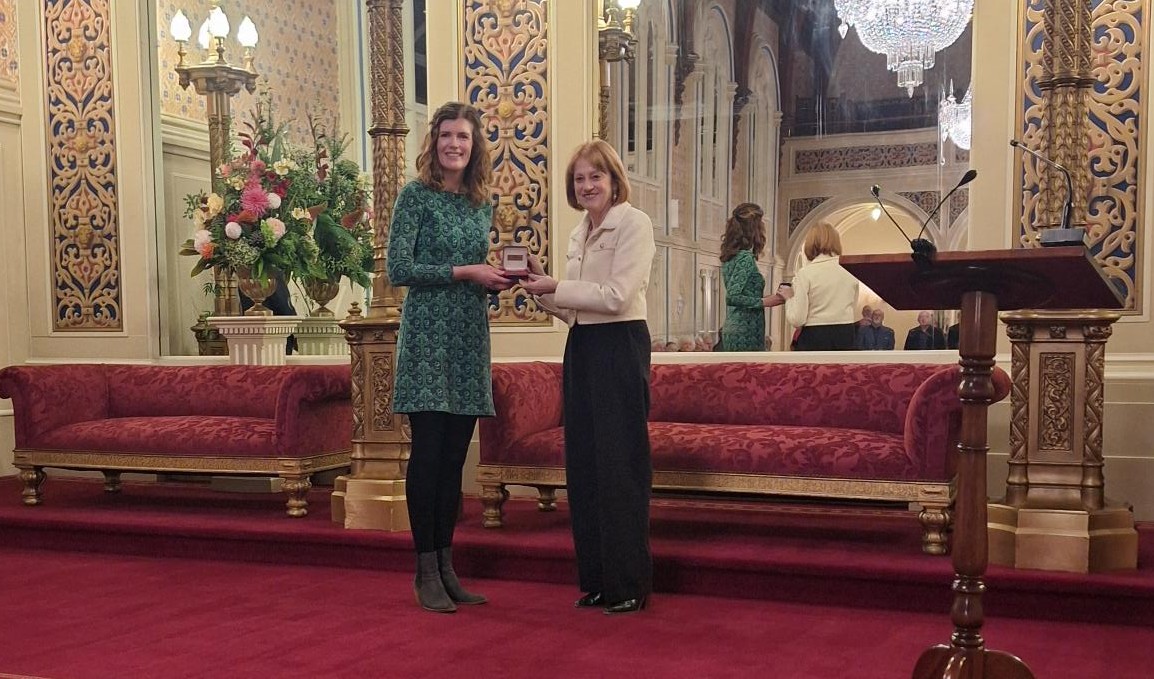
Australian Centre for Excellence in Antarctic Science (ACEAS) Chief Investigator, Associate Professor Dr Jacqueline Halpin from the University of Tasmania, has been awarded one of Tasmania’s most prestigious scientific honours, the Max R. Banks Medal, by the Royal Society of Tasmania.
The medal recognises outstanding and sustained contributions to science, particularly in fields associated with Tasmania’s natural environment. Named after renowned Tasmanian geologist Max Banks, the award is presented annually to a mid-career scientist whose work has significantly advanced knowledge and understanding in their discipline.
Dr Halpin is widely recognised for her research into the evolution of continents over deep time, using geological evidence preserved in rocks and minerals to reconstruct how Earth’s surface has changed across millions to billions of years.
Based at the Institute for Marine and Antarctic Studies, her research bridges both terrestrial and marine settings. In 2023–24 Dr Halpin led the geology team in remote fieldwork to the Denman Glacier region, providing crucial new samples and data for interdisciplinary Earth–ice sheet science. Part of this work includes testing a recent model of the assembly of the Gondwanan supercontinent, including the formation of the Gamburtsev Subglacial Mountains – a vast mountain range buried entirely beneath the East Antarctic Ice Sheet.
Sometimes described as ‘ghost mountains’, the Gamburtsev range is comparable in size to the European Alps and remains one of the most enigmatic features on Earth. Through analysis of minerals and structures in rare Antarctic rock outcrops, Dr Halpin’s research is helping reconstruct this Gondwanan collision and the formation of these mountains around 600 million years ago.
Currently, Dr Halpin’s work is focussed on Antarctica’s past, using geological records to understand how ice sheets responded to prior warmer climates. By understanding these mechanisms, her research contributes to improving projections of how the Antarctic Ice Sheet may behave in a warming world – knowledge that is critical for assessing future sea level rise.
“For me, geology is about connecting past, present and future – using the oldest stories on Earth to help us navigate what comes next,” she said.
ACEAS congratulates Associate Professor Halpin on this well‑deserved recognition and celebrates her continued leadership in advancing understanding of Antarctica, Earth systems and their relevance to climate change.
Subscribe to our newsletter
For more Antarctic news and stories, subscribe to our mailing list here.