Cook Ice Shelf research: why it’s important
By Dr Linda Armbrecht, Australian Centre for Excellence in Antarctic Science / Institute for Marine and Antarctic Studies (University of Tasmania) and Joline Lalime, Sea2SchoolAU
The Cook Ice Shelf sits in a remote part of East Antarctica, but it plays a major role in Earth’s climate system. Recent scientific modelling shows this ice shelf is especially vulnerable to climate change, with projections suggesting significant ice loss over the next 200 years. Despite this risk, the region is one of the least studied parts of Antarctica.
This matters because the Cook Ice Shelf drains a large part of the Wilkes Subglacial Basin, which holds enough ice to significantly affect global sea levels. Around 60% of this basin’s ice flows through the Cook and neighbouring Ninnis glaciers. Without direct data from this region, scientists cannot accurately assess how sensitive this part of Antarctica is to warming oceans and climate change.
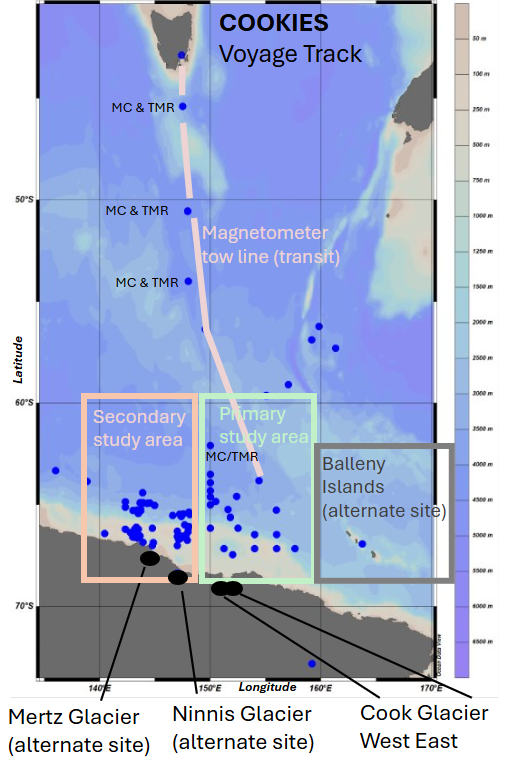
At present, there is very limited information on the ocean conditions, seafloor shape, ecosystems, and long-term climate history of the Cook Ice Shelf region. This research expedition, on the CSIRO research vessel (RV) Investigator is designed to fill that gap by collecting data that will help us understand how ice, ocean, geology, and life interact here, both today and in the past.
One key goal is to study how marine ecosystems near the Cook Glacier have changed during warmer periods over the past one million years. Sediments on the seafloor act like a natural archive, preserving evidence of past climates, ice retreat, ocean conditions, and microscopic life. By analysing these records, we can see how the system responded to earlier warming events and compare that to current conditions.
The expedition will also investigate seafloor ecosystems and biodiversity. Using modern and ancient DNA, deep-sea imagery, and carefully collected seafloor organisms, we can study and begin to understand how life in remote Antarctic waters is shaped by ice cover, ocean productivity, and circulation. This helps reveal how Antarctic ecosystems may respond as conditions change.
A multidisciplinary team of scientists will map the seafloor, collect long sediment cores, sample seawater, measure ocean temperature and currents, and deploy cameras and instruments to study life on the seafloor. The aim is to gather data in front of the Cook Glacier (with alternative sites selected based on ice sheet coverage), as well as, along the expedition route from Australia to Antarctica, building a complete picture of this region from surface waters to the deep ocean.
What happens near the Cook Ice Shelf does not stay there. Changes in Antarctic ice and ocean circulation influence sea-level rise, climate patterns, and ocean health worldwide. By studying this poorly known region now, scientists can improve climate models, reduce uncertainty in future projections, and better inform decisions that affect communities far beyond Antarctica.
Research in the Cook Ice Shelf region is not just about exploring an unknown place – it is about understanding how our planet works, and how it may change in the decades to come.
Join us on the expedition
The research on the expedition will be showcased through blogs released through the Australian Centre for Excellence in Antarctic Science and can be followed on social media at Sea2SchoolAU Facebook, Instagram, LinkedIn and the CSIRO Voyage (IN2026_V01) Page.
This voyage is supported by the Australian Research Council Special Research Initiatives Australian Centre for Excellence in Antarctic Science (Project Number SR200100008), the Australian Research Council's Discovery Projects funding scheme (DP250100886), the COOKIES GEOTRACES process study GIpr13, Horizon Europe European Research Council (ERC) Frontier Research Synergy Grants, OGS – Istituto Nazionale di Oceanografia e di Geofisica Sperimentale, Securing Antarctica’s Environmental Future (SAEF) (Project Number SR200100005) and by a grant of sea time on RV Investigator from the CSIRO Marine National Facility (MNF).
Top header image: ACEAS/IMAS scientists and CSIRO staff during COOKIES voyage preparations in Hobart (Image Credit: CSIRO/Fraser Johnston)


